(to poems by RAINER MARIA RILKE)
with comments on the recording made by SOPRANO FRANCES JAMES and PIANIST GEORGE BROUGH
“Frances James flies from Los Angeles to prepare for recording of ‘Das Marienleben’ with me.” {September 1 1950}
“1st rehearsal with Frances, lasting most of afternoon & evening.” {September 2 1950}
“… Fran & {Murray Adaskin} & I leave by night-train to New York.” {September 7 1950}
“Recording session for Hindemith’s ‘Das Marienleben’ begins at 7 p.m. in a rented studio in New York, directed by Peter Fritsch of ‘Lyrichord’ records. Some preliminary technical hitches resulted in only the 1st 4 being recorded – in 4 hrs., with re-takes. All recorded on tape & played back immediately afterwards …” {September 8 1950}
“To-day’s session from 12 to 8 completed the recording. Many numbers recorded more than once. No.1 5 times.” {September 9 1950}
“Listening to complete tape recordings in ‘Allegro’ warehouse & finally approved by all concerned …. Supper at Paul & Stella Standard’s & late train to Toronto.” {September 10 1950}
“Arrived Toronto. Fran & Murray go to Canoe Lake for a week …” {September 11 1950}
“Plane with Frances to New York & Washington. Met at Airport by 2 St. John’s College Students & driven to Annapolis, Maryland. Staying Corvel Hall. Rehearsing at the Zuckerkandls’ after supper.” {March 1 1951}
“Performance of ‘Das Marienleben’ – St. John’s College, Annapolis … Party at the Zuckerkandls’.” {March 2 1951}
“Lunch at the Zuckerkandls’, tea at the College & some songs from ‘Das Marienleben’ first version, sung in comparison to revised version. Supper at the Zs’ …” {March 3 1951}
“Lunch at Dr. Klein’s, College Dean – followed by more singing at the College – Wolf, Debussy & Fauré.” {March 4 1951}
“Car to Washington, plane to New York, lunch at the Russian tea-room with Peter Fritsch, & an unsuccessful hunt for Berlioz & Schönberg the rest of afternoon. Night plane to Toronto – Frances stays New York till Wednesday.” {March 5 1951}
The whole life of Mary, including its foretelling and its apotheosis, is exquisitely told in the fifteen poems of Rilke’s Das Marienleben. It is poetry that speaks of the Virgin’s pure being, her wonder and joy at bearing a saviour, the depths of her grief over her son’s persecution and brutal death, her own passing, ascendance and glorious reception into Heaven. The story is drawn with such fineness (it seems to me, though I’ve come to know the poems only in a free translation to English) that one finds its transparency hard to grasp hold of, even while being completely pulled in by its gravity.
Not an easy thing to capture in music.
An extraordinary choice of Paul Hindemith’s, to create a song cycle of these poems. How to seize the wondrous? How to depict the miraculous in musical terms? How to express an idea of such fine mesh that it is barely expressible at all? Why he chose to set this work is a matter of speculation, though one does perceive that Hindemith the composer and Rilke the poet are kindred spirits, both drawn to manifest a kind of “mystic exaltation” (to borrow words from writer and music educator R. E. Rodda).
Hindemith set the poems twice, a first version in 1923 (“a work of infectious spontaneity, of divine intuition”, according to Glenn Gould) and a second version in 1948, in which all but two of the songs were subject to a rigorous reworking in an evolved style, using a new tonal symbolism. The composer regarded the second setting as the “definitive” version. In both versions it is a work of about 1 ½ hour’s length, very beautiful in stark and mystical ways but also very complex, difficult for both performers and audience, and rarely performed.
There is a lot of discussion about whether the 1948 version is an improvement over the 1923 version; in any case, in September 1950 Frances James and George performed and recorded the 1948 version. How this project came about involved Hindemith himself, a story that is documented in Gordana Lazarevich’s meticulously researched and mightily interesting book “The Musical World of Frances James and Murray Adaskin”.
The story in a nutshell: James was already well acquainted with the first version of the work; she gave its first Canadian performance in 1943 at the Toronto Society for Contemporary Music and two years later gave its Canadian radio première over the CBC national network. She sang it for Hindemith himself when he visited Toronto in 1946 as guest lecturer at the Toronto Conservatory of Music. Subsequently she worked with the composer on the second (1948) version and performed it in the USA during the summer of 1949. She was then approached by the visionary director of New York based Lyrichord Records, Peter H. Fritsch, to record this “definitive” version; this she did with George, in September 1950.
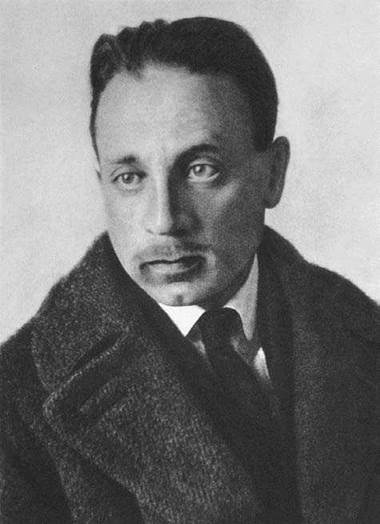
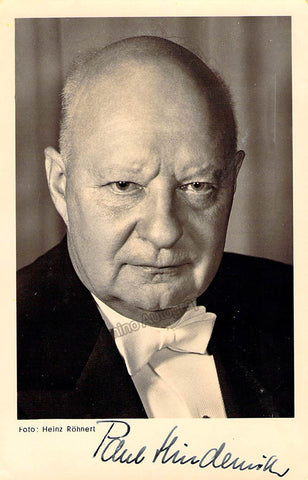
After the second version was published, Frances and George were invited by Viktor Zuckerkandl, a Viennese intellectual who taught classes in poetry and music at St. John’s College in Annapolis, Maryland, to come to the USA and perform the work for his students. George’s diary entries of early March 1951 (above) describe this 5-day adventure made possible by Zuckerkandl, which seems like a mini-whirlwind of music and noteworthy meals.
As well as drawing your attention to Hindemith’s extraordinary Das Marienleben, it is my great pleasure to acquaint you with George’s part in the saga of the making of this recording and performing of the work with Frances James. Here is Lazarevich’s account:
“Toronto-based George Brough was the Adaskins’ accompanist on their 1949 Western tour (see georgebrougharchive.com, Late 1947 to Mid 1950, CONCERT TOURS) and it was Brough whom Frances called upon in an emergency to join her in New York for the recording of Hindemith’s Das Marienleben. The person with whom she had worked on those songs all summer in Santa Barbara in preparation for the recording session proved so unreliable that ten days before the recording date in New York she found herself without an accompanist. George Brough, whose sight-reading facility contributed to his reputation as an expert accompanist, agreed to learn the taxing piano part of Das Marienleben in ten days. He is the pianist on the historic first recording of the Hindemith song cycle for Lyrichord records. Brough also accompanied Frances in Annapolis in 1951, when she sang Hindemith’s song cycle for Zuckerkandl’s class at the college.”
From Gordana Lazarevich: The Musical World of Frances James and Murray Adaskin, Toronto: University of Toronto Press, 1988, Chapter 3: “The Canadian performer in the 1940s” page 120.
The recording made by Frances and George can still be heard on archive.org:
For anyone interested, the full German text of Rilke’s Das Marienleben poems may be found here on archive.org.
The English translations done by Lister Sinclair can be found by clicking through to the archive recording and then selecting the Liner Notes tab at bottom left, then scrolling through the 5 pages.
A bit about the life of activist and world music pioneer Peter H. Fritsch, and about the very interesting history and contributions of his company Lyrichord Records can be found here.
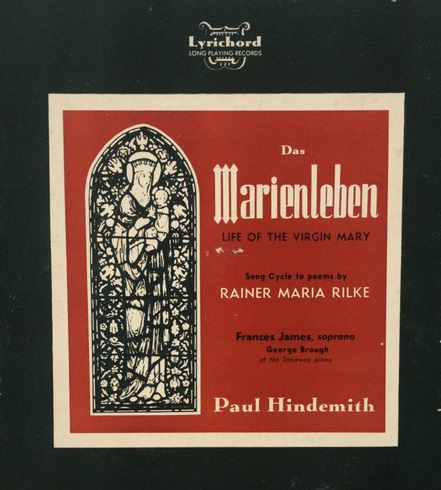
You can read about musicologist Viktor Zuckerkandl in a brief Wikipedia article here.
Finally, the life and art of soprano Frances James deserves its own SPOTLIGHT, a separate feature in the SPOTLIGHTS section of this website.