TORONTO MENDELSSOHN CHOIR, EXAMINING FOR ROYAL CONSERVATORY OF MUSIC, AND TOURS
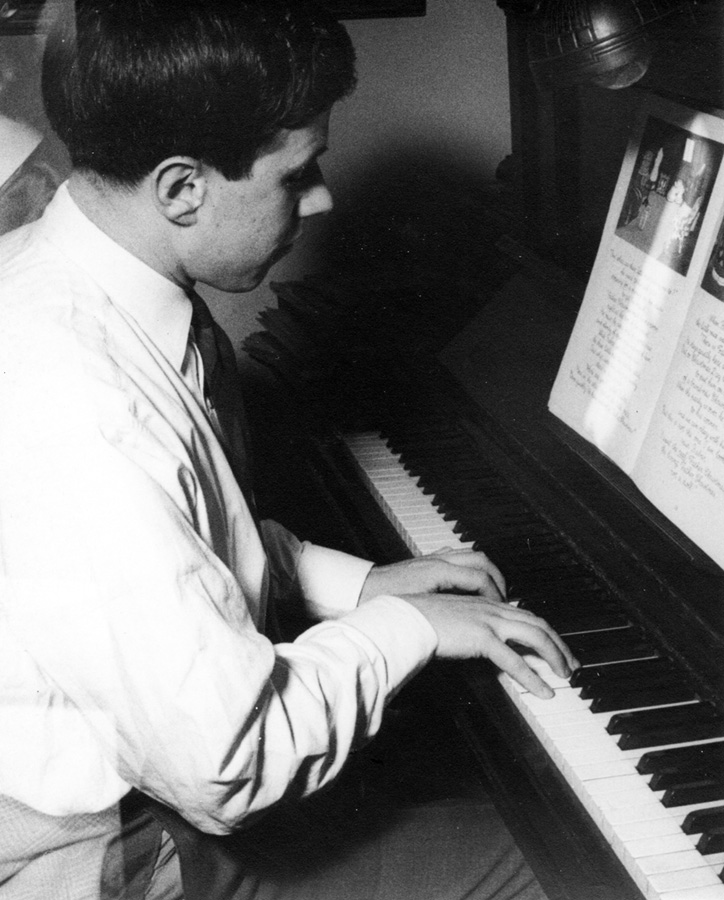
When you enjoy a long life as a practicing musician, you are bound to make lasting and significant associations. Some of these were forged in George’s life during these early years. Amid a lot of diverse musical engagements, broadcasts and various travels, this period notably marks the beginnings of two long and fruitful occupations for him:
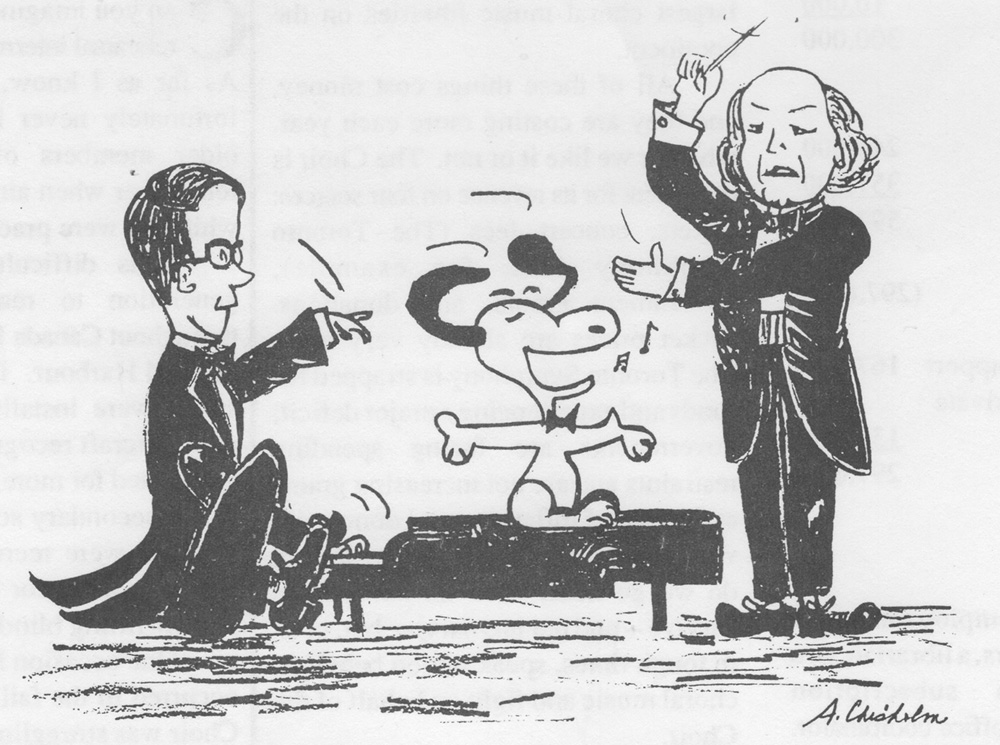
- Work with the Toronto Mendelssohn Choir – tentatively at first, with Sir Ernest MacMillan as conductor:
“Attended first rehearsal of season of Mendelssohn Choir. Works rehearsed: B minor Mass & Belshazzar’s Feast.” {September 13 1948}
“Another voluntary attendance at Mendelssohn Choir rehearsal led to my being one of the accompanists for the full 2 hours (Silvester being the other). Belshazzar & Song of Destiny.” {October 4}
Eventually George was to become one of this large and revered choir’s main rehearsal pianists and accompanists under four conductors, right through to the end of Elmer Iseler’s tenure in the late 1990s.
- And, as examiner for the Royal Conservatory of Music. In 1948 his examination tour was confined to Ontario; 1949 marked his first western RCM tour; in subsequent years this position took him far and wide across Canada, every spring and sometimes in mid-winter for many years – so extensive that it deserves its own page, which will give some indication of the breadth of his travels as examiner throughout the years. (reserved for a future installment)
“To North Bay, by overnight train.” {June 20 1948}
“Arrived North Bay, staying St. Regis Hotel. Examining a.m. at St. Joseph’s College, (overlooking Lake Nipissing) & Assumption Convent p.m.” {June 21}
“Started exam trip west – left Toronto C.N.R. Midnight.” {June 4 1949}
“Arrived Longlac & C.N.R. bus to Geraldton (Geraldton Hotel). Gold-mining & lumber district (Gold at Little Longlac) …” {June 5}
“Arrived Winnipeg, celebrating its 75th anniversary as a city … Left by night-train for Dauphin.” {June 7}
“Arrived Dauphin (Dauphin Hotel) & examining at house of … Left by night-train to Melfort (Saskatchewan).” {June 8}
“Changed trains at Hudson Bay 2.30 a.m. & finally arrived Melfort 7 a.m. Examining at United Church. Later to Zenon Park on the edge in a storm & are there to find only a mud-road from station to Hotel…” {June 9}
. . . and so on to Prince Albert (Saskatechewan), Edmonton (Alberta), Fairview (Alberta), Dawson Creek (BC), Sexsmith (Alberta) . . . And finally (after a 3-day diversion to visit friends):
“Arrived Toronto after absence of nearly 5 weeks.” {July 8}

CONCERT TOURS
Concert touring loomed large in his life. In those days, before digitized musical sounds were all-pervasive and before widespread viewing on screens, concert touring was almost essential for artists to bring their music to audiences. In the vast expanses of Canada, then even more than now, live concerts were eagerly anticipated by people in both large and remote communities.
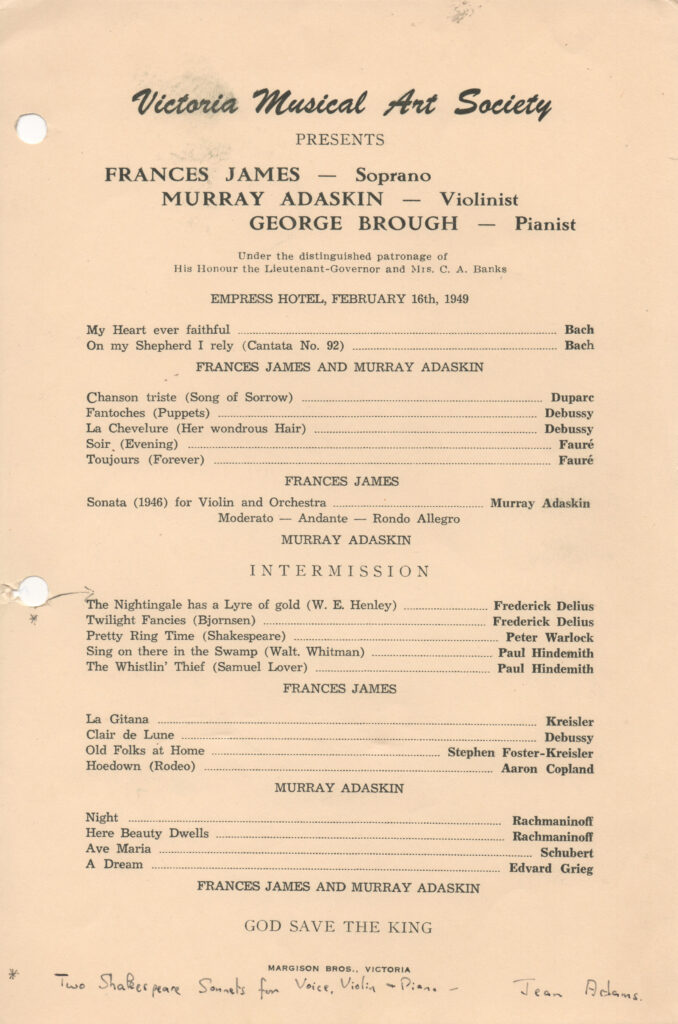
George toured with several musicians during this time: soprano Elizabeth Benson Guy, violinist Gerhard Kander, cellist Boris Hambourg, the violin and soprano duo Murray Adaskin and Frances James. He also made two extensive tours with singers, contralto Portia White and soprano Joan Hammond. For more extensive details of these, see “SPOTLIGHT PORTIA WHITE” (in “The Halifax Years”) and “SPOTLIGHT JOAN HAMMOND” (in this section).
The tour with soprano Frances James and violinist Murray Adaskin (who were a married couple) was especially noteworthy. George sped to the west on a CPR train in the middle of winter for this 9-concert adventure, which began on the edge of Lake Superior in the northern Ontario town of Marathon, continued in Saskatoon, Saskatchewan, took the trio to Banff, Alberta and extended as far west as Shawnigan Lake on Vancouver Island – with concerts in Vancouver, Victoria and Calgary too – finally terminating in Edmonton Alberta, before a long train journey home.
His diary mentions a lot of musical events, celebratory receptions and marvelous new sights on this tour:
“Arrived Marathon, Ont. & staying Everest Hotel. Very cold. Marathon is 5 years old, built around a pulp mill, North shore of Lake Superior.” {January 28 1949}
“Left Marathon 3 hours late, in a blizzard, & sped through the night to Regina, changing trains & going north overnight to Saskatoon & a concert in 3rd Avenue United Church with Frances James & Murray Adaskin. At reception I met fellow who had F.R.C.O. diploma awarded same day as I . . .” {January 30, 31, February 1}
“. . . Dinner Vancouver Club … a Smorgasbord – lavish & colossal . . .” {February 9}
“. . . Visited the famous Stanley Park & saw a totem pole and Lions Gate Bridge. Dinner with Lawren & Mrs. Harris, Canadian painters – a superb house & lovely artists . . .” {February 10}
“… Returned to Victoria last evening. The scenery was exciting & there had been a great deal of snow . . .” {February 15}
Finally:
“Night train to Calgary & just able to catch previous night’s train to Toronto – 12 hours late owing to snow-slide in Fraser Valley . . .” {February 22}
“Arrived Toronto 7.30 p.m.” {February 25}

BANFF
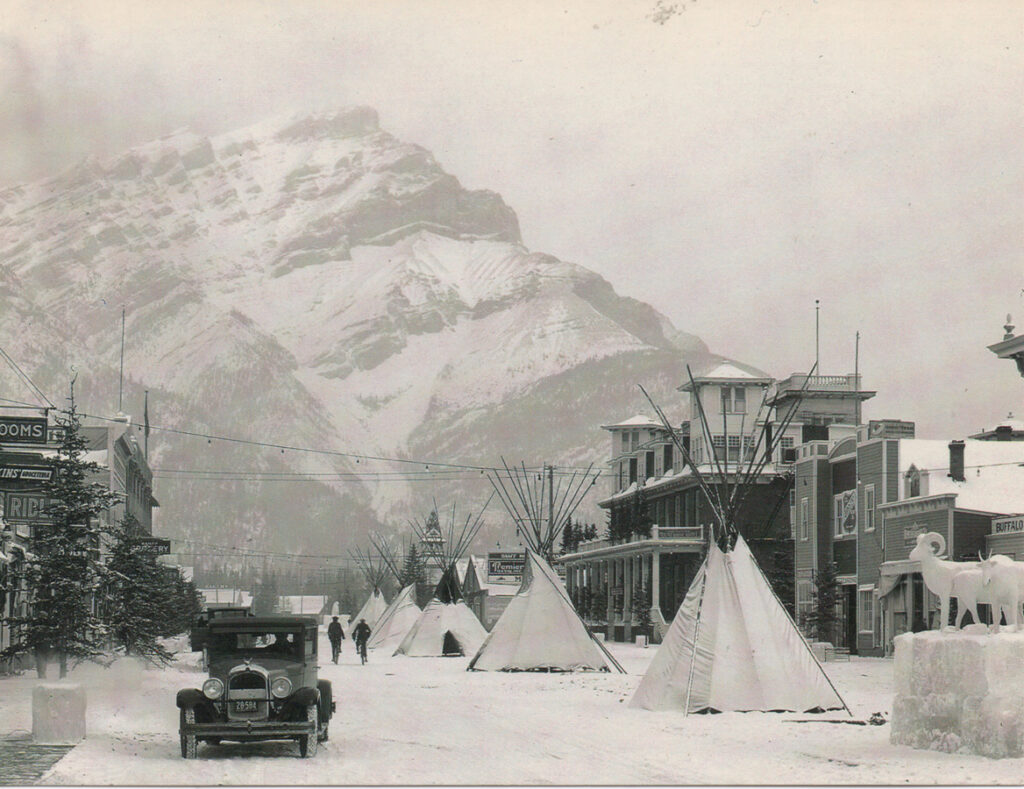
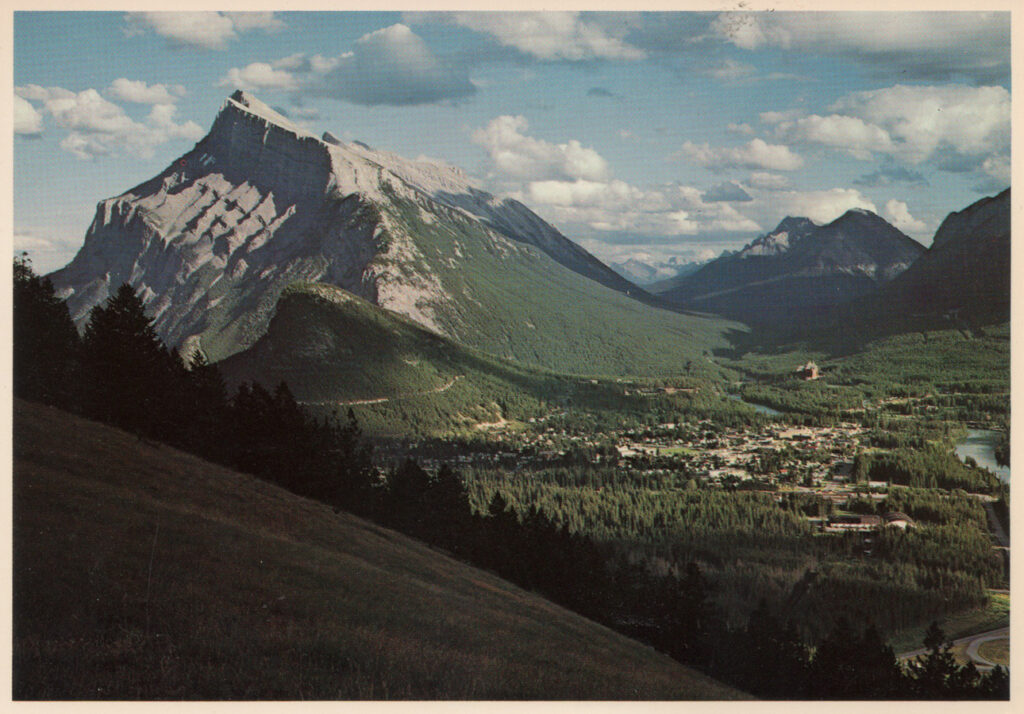
One enchanting place on this tour obviously stands out for him, its allure as strong then as it is now for so many who have been captivated by its extraordinary majesty – and that is Banff, where the scenery is breathtaking, the atmosphere tinged with a rare presence; and those who are attuned to this can never forget it. It is the home of what was then The Banff School of Fine Arts, now Banff Centre for Arts and Creativity. Banff was a place he would return to very often in his life to come.
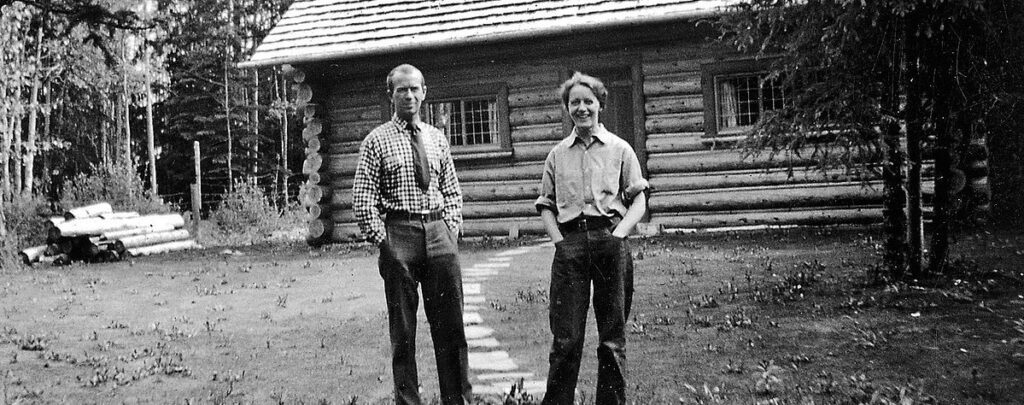
The trio stayed there for four days, performed one concert, and were very hospitably received by Peter and Catharine Whyte who were well-known artists in the area:
“The Whytes (artists) drove us to the Norquay Ski Trail – to a height of approximately 5500 ft. New chair lift has just been inaugurated – this taking skiers up another 1100 ft. almost to the tree-line . . .”
“Evening with the Whytes, seeing slides of Rockies & paintings of Peter Whyte & hearing some very interesting Balinese records . . .” {February 4 1949}
“Today I walk to the Hot Springs, swimming-pool & cave, & Peter Whyte drives us later to the Upper Hot Springs & Swimming Pool (Sulphur Mountain) & to Banff Springs Hotel, closed for the winter, but kindly open for us to inspect . . .” {February 5}
“Magnificent views during the last 3 days. Banff’s mountains seem to be Cascade, Rundle, Tunnel, Sulphur & Norquay …” {February 6}
This was his first visit to Banff but far from his last; it became a central part of his future life because of his work at The Banff School of Fine Arts where he made music for 41 summers. But that is another part of his story, to be celebrated on another page.
COMMENTS ABOUT MUSIC AND OTHER THINGS
“To Glenn’s recital at Eaton’s. He, aged 15, pupil of Guerrero’s, played Scarlatti, Beethoven, & the rest exquisitely. To a reception afterwards at Guerrero’s, attended by eminent musical dignitaries, but it was a crazy affair.” {October 20 1947} (Glenn Gould of course)
“To 1st Art Gallery concert: . . . {including} Lois Marshall, soprano – the latter an amazing voice, full blooded, sparklingly clear & accurate. Very musical. Sang a ‘Seraglio’ aria & Michael Head’s ‘The Singer’ superbly. Later to Mr. Guerrero’s to hear records, Casals & Horszowski Brahms in F. Horowitz & Toscanini Brahms in B flat.” {November 2 1947}
“To Dr. Peaker’s recital Convocation Hall, an all-Willan programme & excellently presented, entirely from memory. Composer was there too & took a bow. Later to two-piano recital at Massey Hall – Lyboshutz & Nemenoff. Fine performance & perfect unanimity between the two artists.” {November 3 1947}
“Met Healey Willan for the 1st time. To Symphony Concert. Ernest {MacMillan} {conducts} as usual from memory. Brahms Haydn & Don Quixote. Jeanne Gautier & Zara Nelsova … perform Brahms Double.” {December 9 1947}
“To the Goulds for supper. Glenn has a recording machine with which we experimented. Recorded Bach’s Organ Fantasy & Fugue in G minor arr. piano duet.” {May 4 1948}
“To the third of Gerald Moore’s accompanying classes at the Conservatory.” {July 13 1948}
“Accompanying class no. 4. I play 1st 5 of Dichterliebe.” {July 15}
“Accompanying Class no. 5. Dichterliebe continued.” {July 20}
“Accompanying Class no. 6. I play two of Wolf’s.” {July 22}
“Gerald Moore class no. 8. Last class. I play 2nd movement of Franck . . .” {July 29}
“Clothes-rationing ends in Britain, after 8 years. Nova Scotia is to get a bridge from the Mainland to Cape Breton, 3000 ft. long, 3 years to build, costing 13 ½ million dollars. T.S.O. play Pictures at an Exhibition, Tchaikovsky 5th, Bach Suite in D & Bach-Walton ‘Sheep’.” {March 15 1949}
“Newfoundland becomes Canada’s 10th Province.” {April 1 1949}
“French Airliner crashes on San Miguel island in the Azores on way to New York. 48 passengers – no survivors. On board was Ginette Neveu, French violinist, on way to concert tour in Canada & U.S.A.” {October 28 1949}
George’s writing is generally quite amiable, so the bits of spice he sprinkles in from time to time are surprising to read. Without revealing too much (he wrote the diaries for himself only) here is a small handful:
“. . . completely lifeless with no thrills & how dull the witch’s scene is without thrills.”
“. . . Many of performers needed to embark on a slimming diet.”
“. . . so bad that I had to depart during intermission. And the pianist was a . . . {letters after name} – Heaven knows why or how!”
“. . . Minister has 7 cats & 1 wife . . .”
“. . . we returned with a cheesy full moon rising behind us . . .”
“. . . staying at Swan Hotel (& what a cold & dirty Swan)”
“. . . I reveal myself to . . . concert manager & I coax her to ask assistant manager for a practice piano. This matures eventually in the ballroom – but what a piano!”