SHORTCUTS: INTRO | A BRIEF HISTORY | THE MUSIC PERFORMED | CANADIAN COMPOSERS | EPILOGUE
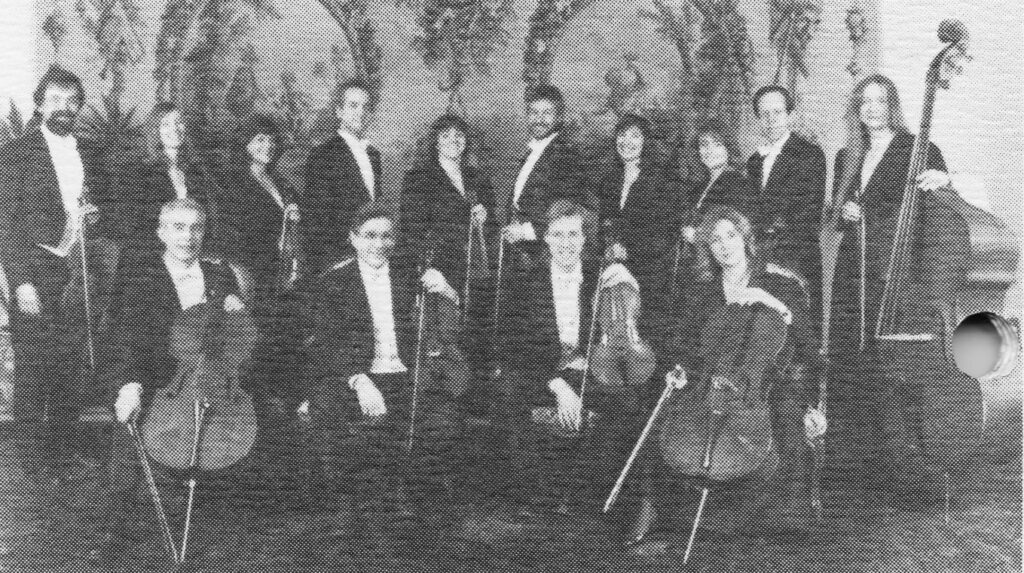
A chamber orchestra that endures for 23 years, though not unheard of, is a special thing. It will inevitably have weathered the changes that time brings, new musicians replacing old, artistic vision shifting as new leadership takes over.
But the enthusiasm that originally gave birth to it – love for the music that insisted “Play me!”, care lavished by the performers in striving toward the best possible musical renderings, and appreciation with which the listeners responded – surely these have been its sustaining forces. Such a lasting group is a coveted, you might even say a necessary thing.
A special thing too, is to remain part of that group for all its 23 years – again not unheard of, but definitely remarkable.
Among such enduring groups was The Chamber Players of Toronto, and among its personnel was George, whose involvement as keyboardist spanned the very first concert (in February 1969) to the very last (in May 1992). Though he was occasionally replaced by another keyboard player, this happened relatively infrequently – perhaps because of conflicting engagements.
Mentions of CPT in his diary are as brief as ever, but I counted about 155 of them. They disappear abruptly at the end of 1985 simply because he abandoned the diaries then, never to take them up again. But 33 more CPT programs after 1985 exist in his paper files, with his name almost always there as “harpsichordist”, “pianist”, “organist” or “continuo”, attesting to his presence right up to the disbanding of the group (he is mentioned in that last program as the harpsichordist).
George’s first mention of the new chamber orchestra in his diary:
“Playing harpsichord in debut concert of Toronto Chamber Orch, in St. Lawrence Hall.” {February 20 1969}
and almost 17 years later, his last entry:
“C.P.T. concert III for which I could not play (conducted by Simon Streatfeild).” {December 18 1985}
A BRIEF HISTORY
George left two sources by which to follow the saga of The Chamber Players of Toronto: his diary entries, and well over a hundred concert programs that date from 1969 till 1992. (Did he do this intentionally, foreseeing their discovery by a curious 21st-century scribe?) To be sure there are some gaps especially in the later years, but all told they constitute a relatively complete account of CPT performances over the years, and are a good indication of the vitality of the group – revealing not only their own 23-year concert series but also many events mounted by other groups in which they performed.
Viewing it all from my distant vantage point, I feel the cultural atmosphere of another, more innocent time, before almost all information, almost any music and almost any performer could be accessed with the mere flick of a finger. Back then, we had to go to greater lengths to seek out the music we wanted to hear.
As well, I imagine the story of a dearly loved and slightly precocious child who grows, develops, reaches for the sky, but – the sky being just out of reach – inevitably must fall to his demise.
BUT, not without leaving the legacy of a large body of music lovingly presented and shared – enough to enrich the cultural awareness of a city and well beyond.
Two brief paragraphs describe the genesis and early growth of the organization:
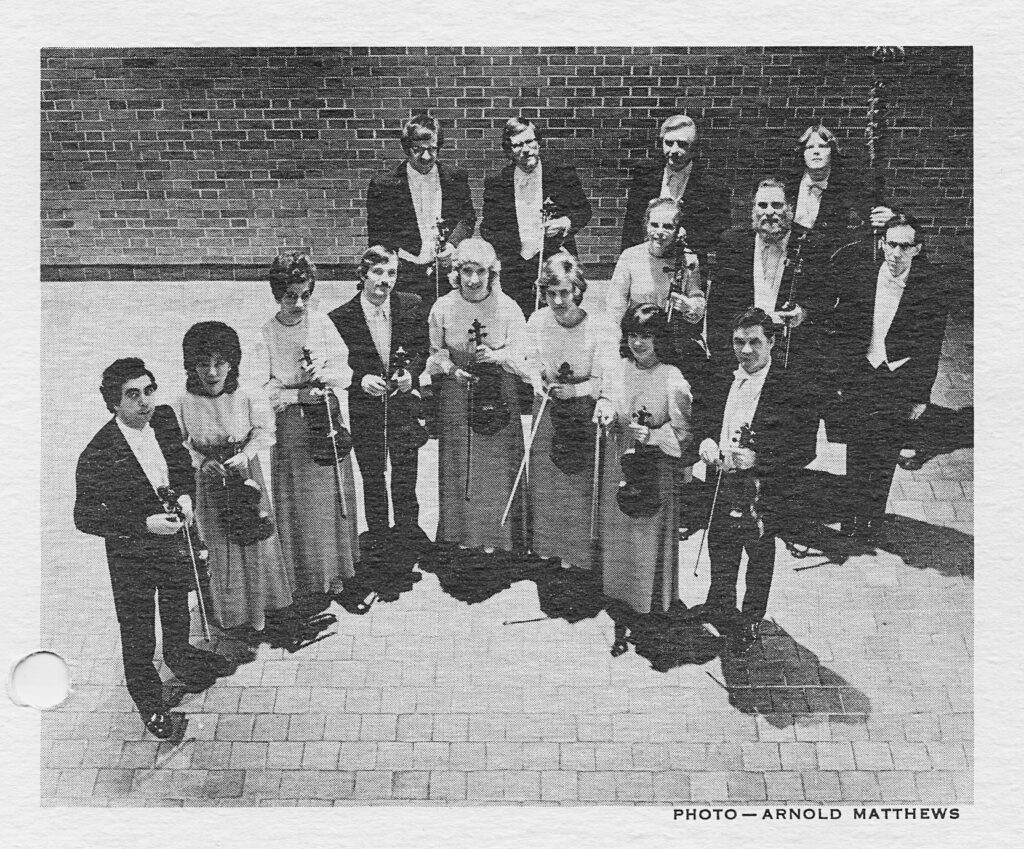
“THE CHAMBER PLAYERS OF TORONTO grew from an idea that there were a number of young professional musicians available who love performing chamber music. Ontario would appear to need a group of this kind. The musicians themselves came together for the purpose of creating a first-class ensemble. The players have created both the organization and the music. They are dedicated young professionals and teachers who perpetually strive to improve the effectiveness and the standards of their performances. … During the summer of 1968 (the first CPT music director, violinist Victor Martin) arrived in Toronto to teach in the Faculty of Music at the University of Toronto.”
(from April 10 1969 program)
There were five music directors in all:
● Violinist Victor Martin was first, beginning with the initial concert on February 20 1969 and remaining till the end of 1976-77 season.
● Violinist Marta Hidy replaced Martin for the 1977-78 and 1978-79 seasons.
● With Hidy’s resignation came violinist Winston Webber, 1979-80 to 1981-82.
A series of guest conductors carried on, until:
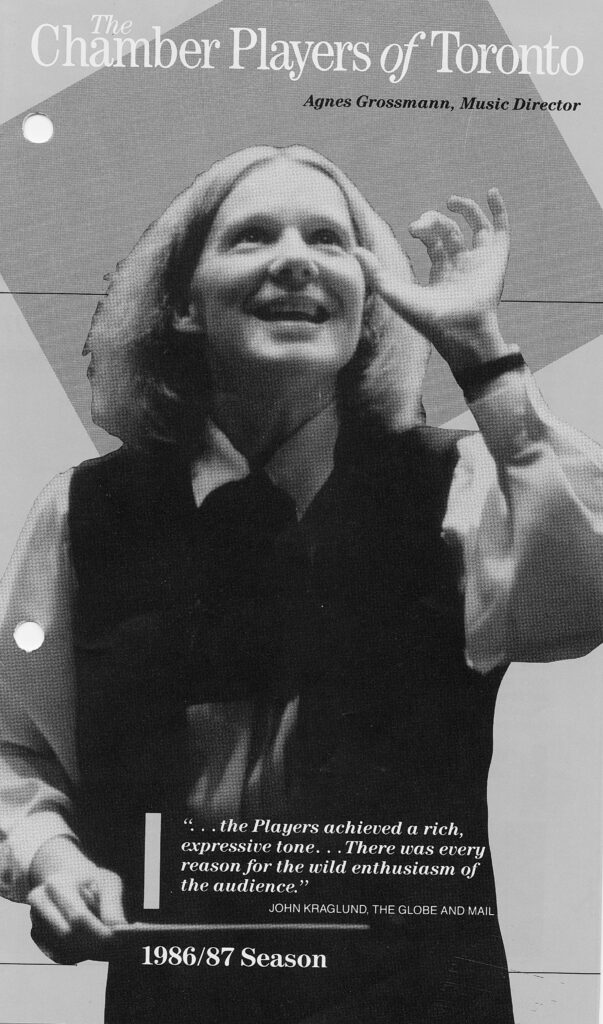
● Conductor Agnes Grossmann assumed the directorship from 1984-85 to 1990-91.
● Finally, the young conductor Paavo Järvi served as last CPT director, 1991-92 season.
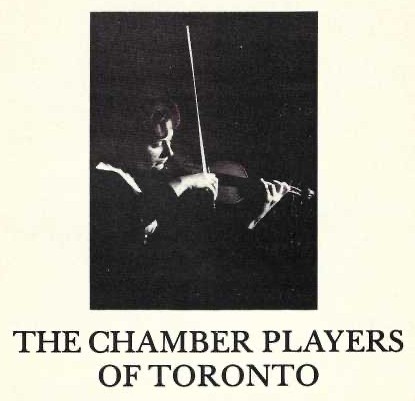
“Our decision to present two series has been made to some extent as the result of the continuing demand for tickets to the Chamber Players’ concerts, but mostly because of the very enthusiastic response to a questionnaire put to our own subscribers last spring. The Players sincerely hope that their music will continue to please the many faithful members of our audience without whose support the concerts could not continue, and that with the two series, we can add many new names to our list of subscribers …”
(from 1973-74 season brochure)
The two series differed: Series A presented music ranging from the Baroque to the Twentieth Century, and Series B was devoted exclusively to music from the Baroque.
The need for such a chamber orchestra manifested itself in other ways as well.
Like a force unleashed, CPT began to appear in many different places, and in several different roles. George describes 42 such events in his diaries; I’ve chosen 14 of them to point out the variety:
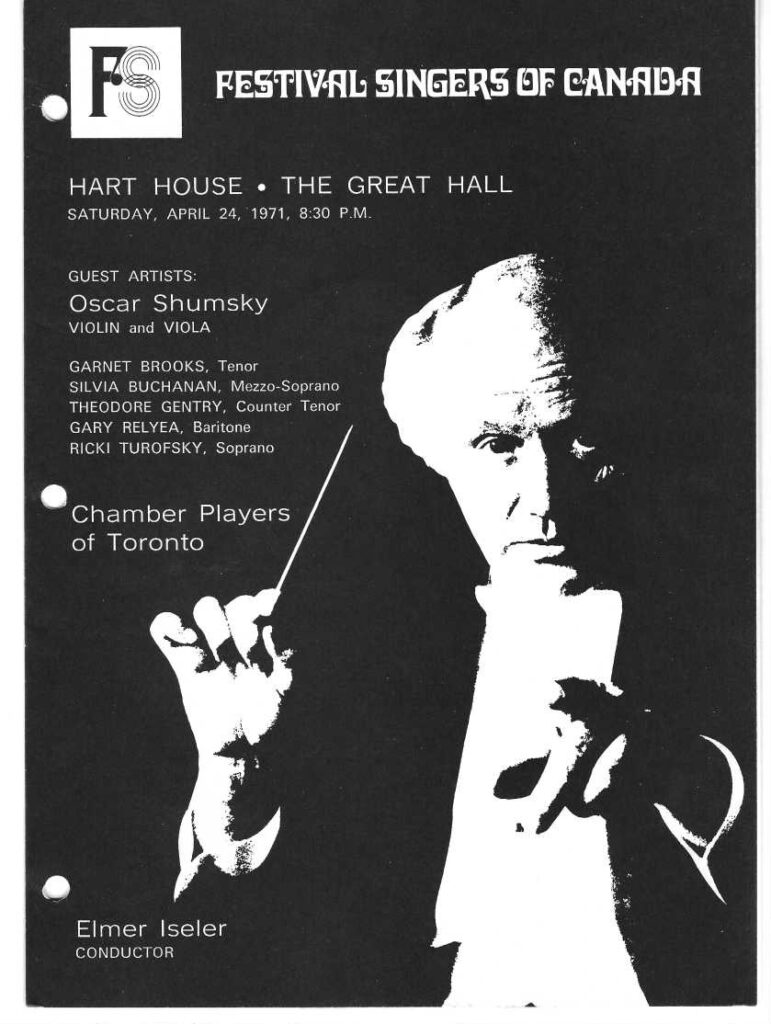
“Playing harpsichord in Festival Singers concert with Chamber Players in Hart House – “Birthday Ode for Queen Anne” – Handel.” { April 24 1971}
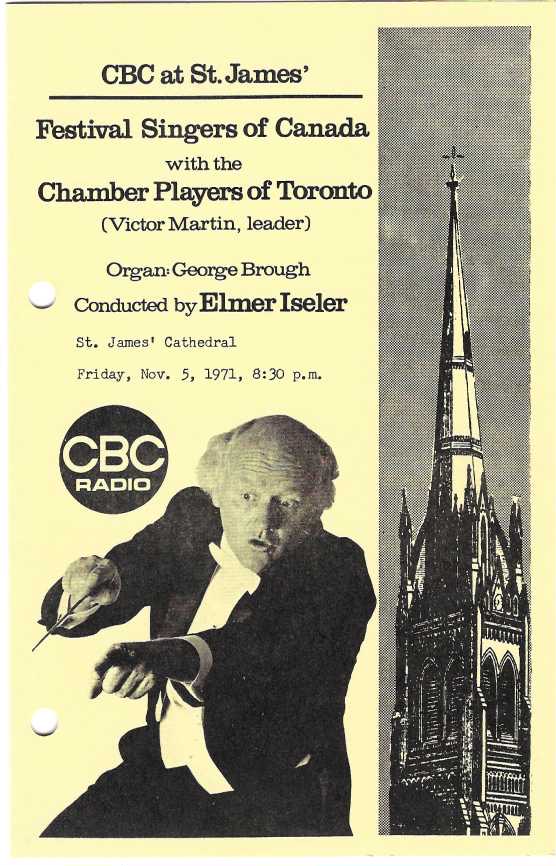
“Playing organ for Festival Singers concert & broadcast at St. James Cathedral, with Chamber Players.” {November 5 1971}
“To Waterloo with Chamber Players, for concert at University. I play the Bloch Concerto Grosso.” {November 11 1972}
“With Chamber Players to Windsor (by bus) for concert at Cleary Auditorium.” {April 8 1973}
“With Chamber Players to a North York School for 2-hr. workshop.” {April 12 1973}
“TV production of “Music to See” with Chamber Players of Toronto.” {October 10 1973}
“To Sarnia by bus with Chamber Players for concert in High School. Freezing rain on the way, later, plenty of ordinary rain.” {January 20 1974}
“To Quebec via Air Canada for concert with Chamber Players in Opera House complex. Return to Toronto 2 a.m.” {January 19 1975}
“Toronto Chamber Players accompany Concord Singers in concert at St. James. I play organ in Haydn Mass & Britten’s Saint Nicolas. Derek Holman conducts.” {March 1 1975}
“To Guelph with Chamber Players to play in Chalmers United Church in “Merry Organ” series – Mary Lou Fallis soloist.” {January 23 1977}
“Handel’s “Samson” at Metropolitan Church conducted by Melville Cook. I play organ, strings from Chamber Players, & winds & timps.” {February 19 1977}
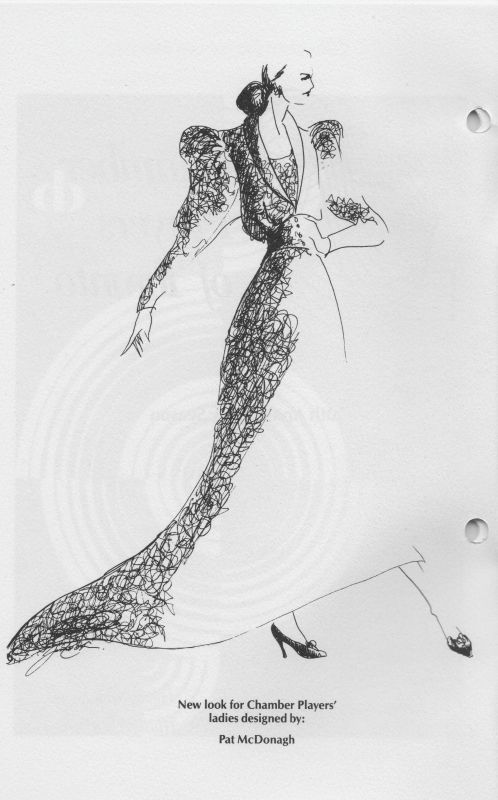
“Chamber Players give concert at Hart House in 18th century costume for audience & radio broadcast on Eric Friesen FM morning show.” {March 20 1977}
“Playing Mozart Requiem at concert at St. Georges United (organ – with Chamber Players).” {March 8 1980}
“With Chamber Players to Kitchener & concert at Kitchener Waterloo University.” {March 4 1981}
“Chamber Players give a free mid-day concert at Harbourfront.” {October 11 1981}
It’s gratifying to have your work recognized by donor agencies too:
“The Chamber Players acknowledge with gratitude the support of the Ontario Arts Council.”
(from November 21 1970 program)
“The Chamber Players of Toronto acknowledge gratefully the support of the Ontario Arts Council and the Canada Council.”
(from December 9 1972 program)
By the end of the 1979-80 season there is a substantial list of donor agencies, from the Canada Council to the Hudson’s Bay Company to several foundations.
In many aspects they flourished, on an ever-upward trajectory of success.
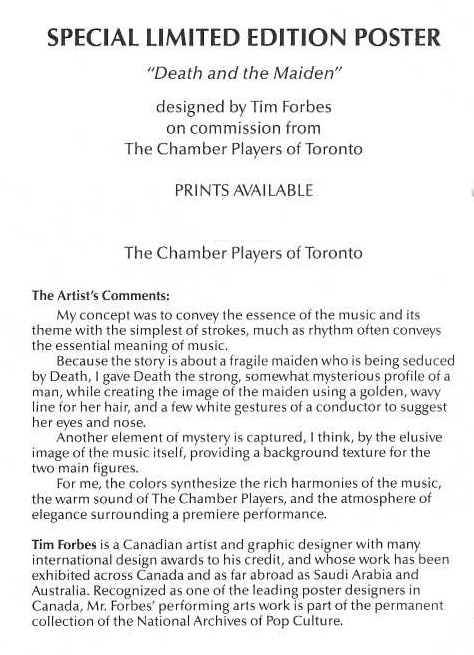
They engaged world-class guest soloists such as contralto Maureen Forrester (November 1986), cellist Janos Starker (December 1984, February 1987), pianist Abbey Simon (January 1992). Commissions added to their vitality – ten new pieces from Canadian composers, a harpsichord from maker Matthew Redsell, a limited edition poster “Death and the Maiden” from artist Tim Forbes.
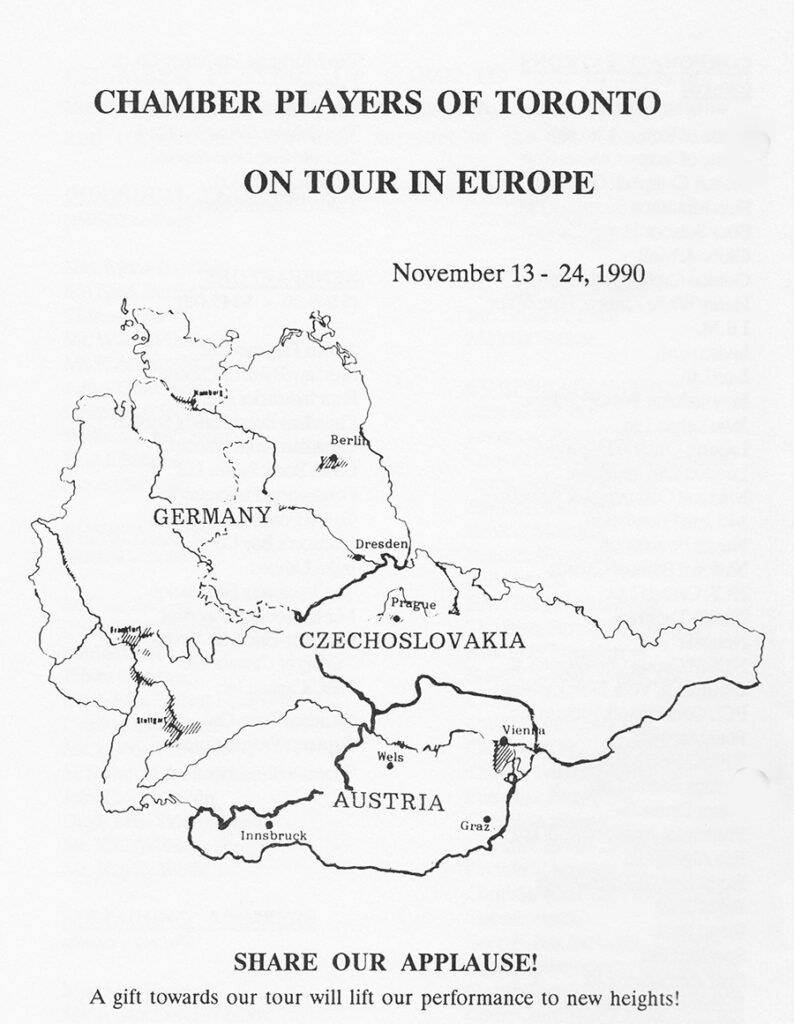
With the achievement of their 20th anniversary and under the imaginative and ambitious leadership of Agnes Grossmann, there was a tour of Germany, Czechoslovakia and Austria (November 13 to 24 1990).
However, as early as 1980, alarm bells began to ring with reports of financial difficulties:
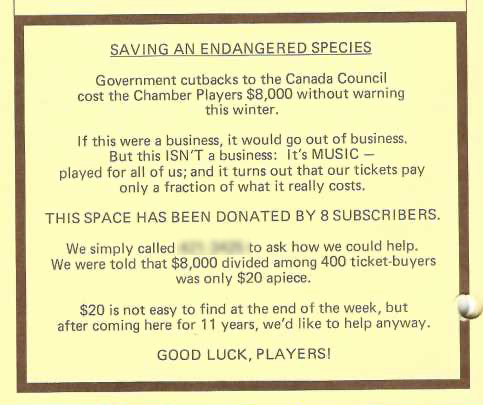
A frank and explicit letter from the CPT Co-managers accompanied the above. Too long to reproduce here, it laid out the financial situation clearly, describing the ripple effect that began with federal government cuts to The Canada Council, travelling down through the cultural chain to performing arts organizations such as The Chamber Players of Toronto. Fundraising inevitably increased, in both corporate and private sectors.
There was new hope for the 1991-92 season, when the young, talented Estonian-American conductor Paavo Järvi was hired as CPT’s new music director. Järvi’s aspirations for the group were evident. Indeed, in that season’s programs (October 24 1991, January 30 & February 27 1992) the plan to record their first CD in June 1992 was mentioned; however this project was never accomplished. (Järvi has since gone on to an international career, widely recognised as one of today’s most eminent conductors and recording artists.)
Two messages greeted the audience at the beginning of the April/May 1992 program:
Message from Music Director Paavo Järvi:
“… we are strong in our decision to save the future of Chamber Players by cancelling two concerts. …
But we are back with music of beauty … As we put the final touches on next year’s season … my goal is to present high quality music, familiar and new, from this continent and abroad. I look forward to sharing with you a rich musical feast in 92/93.”
Message from President Robert C. Manion:
“Hello, and welcome to our April and May concerts. The past few months have been especially difficult for Chamber Players, and we as a Board have had to make some very difficult decisions.
“We know you have been disappointed to lose two concerts, and we certainly have been as well. But by being prudent and fiscally responsible, we are fulfilling our mandate as trustees and good corporate citizens, and our much-improved financial projections seem to say we did the right thing for our future. Without drastic action, our deficit this year would not have been manageable, but it is now …”
The rest, it seems, was silence …
and so at last, it was over.
THE MUSIC PERFORMED
“The Chamber Players of Toronto has a unique place in our city’s musical life. We bring you music with warmth, intensity and clarity which can only be created by an orchestra of our size … Discover the special palette of sound colours, the transparency and intimacy of our chamber orchestra with its unique repertoire, revealing a world of its own …”
(from Agnes Grossmann’s welcome note, 1986-87 season brochure)
Let your imagination take you back to the Toronto of the 1970s and ‘80s, before the days of Spotify, YouTube, even CDs. A different milieu from today’s, in which it’s often hard NOT to be exposed to all sorts of music at every hour, so much so that one becomes supersaturated with the constant wash of sound and forgets to listen …
You as a music lover might choose to subscribe to a concert series in order to experience the freshness of live music; perhaps you’d remain a faithful subscriber to a chamber group for the whole 23 years of its existence. If that group was The Chamber Players of Toronto, the treasure trove of jewels showered upon you would be astonishing, providing you with a musical education to feed a lifetime.
“WHAT A SHINING COLLECTION OF MUSIC INVOLVING STRING ORCHESTRA!!”
I shouted as I perused George’s programs.
Indeed.
As there is too much to talk about, I’ve made my own random choices, hoping to cover most of the styles and periods represented over the 23 years – just a few of the hundreds of pieces I might have mentioned performed by The Chamber Players of Toronto. What follows here may seem a pretty dry list at times; the only way to sweeten it is to listen to the music, which is anything but dry! You are encouraged to seek out pieces you don’t know.
● You would hear pieces for string orchestra you’d expect, such as the lovely string serenades (each more ravishing than the last) by Edward Elgar (February 1971, November 1973, October 1977, December 1989), Pyotr Ilyich Tchaikovsky (November 1971, April 1974, January 1976, December 1982, October 1985, October 1991) and Antonin Dvorak (January 1978, September 1978, February 1984, December 1987, January 1991), as well as Gustav Holst’s fond gift to his students, the “St. Paul’s Suite” (April 1969, February 1974). You’d feel the pure joy and perfect northern sunshine of Edvard Grieg’s homage to his countryman, his “Holberg Suite” (March 1984). Wolfgang Amadeus Mozart’s irresistible “Eine kleine Nachtmusik” was performed several times (February 1970, April 1973, April 1977, April 1987, January 1992).
But more unexpectedly, Mozart’s “Serenata Notturna” – charmed with delights, peppered with timpani! (November 1971); the lyrical, not-so-often-heard Serenade by Josef Suk (January 1979, February 1985); Samuel Barber’s Serenade Op.1, an almost unknown early work, his characteristic freshness breathing through (October 1991).
Listen to Barber's Serenade Op.1 on YouTubeAlso the youthful, warm-hearted Serenade by Ermanno Wolf-Ferrari which begs to be heard but almost never is (December 1990).
Listen to Serenade by Ermanno Wolf-Ferrari on YouTube● Famous Italians of the baroque were well-represented: Vivaldi, Geminiani, Corelli, Locatelli, Tartini, Pergolesi, Albinoni, who made immeasurable contributions to the development of string technique and sound.
You’d have the opportunity to get to know Antonio Vivaldi’s “The Four Seasons”, as it was presented five times in its entirety with three different soloists (Victor Martin, Gerard Kantarjian, Marta Hidy) between 1969 and 1988.
Seven of Arcangelo Corelli’s twelve Concerti Grossi Op. 6 make numerous appearances between 1971 and 1988. These are among the first and finest examples of the concerto grosso, in which the spotlight is on a smaller group (in this case, two violins and a cello), balanced and supported by a larger group. They were widely performed in Corelli’s day, and as he was a violinist of the first order, Corelli himself would have played one of the solo violin parts.
“… in the purity of their string writing, the perfection of their formal balance, their nobility of tone, (Corelli’s Op. 6) laid the foundation for all future composition in this genre.” (from the February 1975 program note)
In a slightly later era, George Frideric Handel (not an Italian, but he absorbed the salient elements of the Italian style to perfection) took Corelli’s works as models for his own masterful group of twelve Concerti Grossi. Eight of them appear in CPT programs between 1969 and 1988.
According to H. C. Robbins Landon, “… these are masterpieces of design, of an endless melodic beauty and with a profound knowledge of the string family.” (page 167 of his book “Handel and his World”)
Béla Bartók in the 20th century would approach the form very creatively; his “Divertimento for String Orchestra” (1939) uses the same elements but often inverts the roles of smaller and larger groups – the solo voices sometimes hushed and fleeting, the larger group seizing the spotlight. (performed in October 1977, May 1981, November 1989).
Listen to Bartok's Divertimento for String Orchestra on YouTubeBack to Handel: Rich operatic treats were in store in September 1979, when mezzo soprano Lois Marshall graced the stage with three exquisite Handel arias, from the operas “Serse” (you would recognize the beautiful ode to a plane tree “Ombra mai fu”), “Rodelinda” and “Admeto”. The addition of two of his operatic overtures, from “Agrippina” and “Serse”, proved beyond a doubt Handel’s great gift for drama.
For the installation of the new organ at University of Toronto’s Edward Johnson Concert Hall in December 1973, two Georges – Handel and Brough – were very much part of the celebration.
“Chamber Players concerts 2.30 & 8.30 in which I play Handel’s Bb Concerto no.2 & the Albinoni Adagio on the E.J.B. organ.” {George’s diary entry of December 8 1973}
● Was it variety you wanted when you subscribed to The Chamber Players of Toronto? You would not be disappointed. You’d hear:
… music that “alone held the key to a wild parade”: Benjamin Britten’s “Les Illuminations”, sung by soprano Riki Turofsky in January 1979, and by tenor Mark DuBois in May 1982.
… music that pictured a rather unruly but ultimately good-humoured battle: Heinrich Biber’s “Battalia”, in which certain sonic shenanigans as only stringed instruments can produce are written into the score (December 1973, February 1976, April 1981).
… music that tilted at windmills: Georg Philipp Telemann’s “Don Quixote Suite” (November 1971, December 1974, October 1981)
“Telemann possessed a sense of fun which could inject fresh life into the overworked forms of his day” (from the December 1974 program note)
… music to make a famous conductor smile, as requested by New York Philharmonic conductor Dmitri Mitropuolos – David Diamond’s “Rounds for String Orchestra” (1944) was performed by CPT in December 1990.
… music weeping at a mother’s sorrow:
Giovanni Battista Pergolesi’s “Stabat Mater” with soprano Rosemarie Landry and mezzo soprano Catherine Robbin (April 1985); and Antonio Vivaldi’s “Stabat Mater” with mezzo soprano Janice Taylor (October 1987).
… music that announced a holy birth, a “hallow’d and gracious” time – the knowledge uttered first in Shakespeare’s Hamlet, and wonderingly recaptured by solo violin and harp in Jean Coulthard’s “The Bird of dawning singeth all night long” (January 1991).
Listen to Jean Coulthard's 'The Bird of dawning singeth all night long' on YouTubeSome say that ever ‘gainst that season comes
Wherein our Saviour’s birth is celebrated,
This bird of dawning singeth all night long;
And then, they say, no spirit dare stir abroad,
The nights are wholesome, then no planets strike,
No fairy takes, nor witch hath power to charm,
So hallow’d and so gracious is the time.
Hamlet – Act 1, Scene 1, Lines 175-179
… and music that bore the burden of a death, a funeral procession stepping ponderously, the knowledge tolled by the intermittent peal of a chime, in Arvo Pärt’s “Cantus in Memory of Benjamin Britten” (February 1992).
● You might gain instruction (if you were interested) from what music composed for ballet has to tell you: For instance, a lovely early ballet by the young Igor Stravinsky, “Apollon Musagète”, very appealing neoclassicism which seeks nothing more than to lend atmosphere to the interactions between the god Apollo and his muses Calliope (muse of poetry), Polyhymnia (muse of mime) and Terpsichore (muse of dance and song) (performed by CPT in November 1983).
Listen to Stravinsky's Apollon Musagète on YouTubeJean-Baptiste Lully, on the other hand, was Master of the King’s Music and as such, he aimed to reflect the glories of King Louis XIV of France, the Sun King; his operas and ballets are dazzling, aristocratic, fragrant with French perfume; their cultured suavité came to define the French baroque style. The multi-movement suite from his ballet “Le Triomphe de l’Amour” (first produced in Paris in 1681) was performed by CPT in November 1978 and March 1986.
Listen to Lully's Le Triomphe de l'Amour on YouTube● There would be other tastes of France over the years, music from the high Baroque to the twentieth century, sensuous and spicy, delicate and cheeky – always elegant. François Couperin’s “Pièces en concert” for instance, arranged for cello and string orchestra with solo cellist Tsuyoshi Tsutsumi (“exquisitely poetic music” says the program note) (March 1977).
Listen to Couperin's Pièces en concert on YouTubeThe harp, with its sparkling personality so suited to the French character, was the featured instrument on two occasions, when Claude Debussy’s graceful “Dances for Harp and Orchestra” were performed, in January 1978 with harpist Sarah Davidson and in March 1986 with harpist Erica Goodman.
Listen to Debussy's Dances for Harp and Orchestra on YouTubeBut if you wanted the other end of the sonic spectrum, the powerful resonance of the pipe organ would loom large for you in Francis Poulenc’s “Concerto in G minor for Organ, Timpani and Strings”. Poulenc, the suave Parisian, described his 1938 piece thus: “a Poulenc on his way to the cloister, a fifteenth-century Poulenc, if you like”. For this, CPT took advantage of Grace Church on-the-Hill’s 3-manual Casavant and was joined by organist Patrick Wedd and timpanist David Campion (February 1990).
Listen to Poulenc's Concerto in G minor for Organ, Timpani and Strings on YouTube● English music: What is it about the English sensibility that comes through so poignantly in music for strings? Perhaps it’s the silken zephyrs of bows drawn across strings, and the visceral stirring of ancient modal harmonies, that awaken a remembrance of some primordial northern landscape … (George might know.)
You might have been touched by this peculiar English element several times over the life of CPT, for instance by any of four performances (see above) of Elgar’s wistful Serenade for Strings which sings of deep longing, an early work from an Old Soul; or by Britten’s “Variations on a Theme of Frank Bridge”, a precocious flowering of Britten’s youth and his daring tribute to his teacher (December 1989); or by the masque and pageant of Henry Purcell’s music for “The Faerie Queene” (December 1975), by evocations of frail shimmering summer beauty in Frederick Delius’s “Two Aquarelles” (October 1978); by the “straightforward, unpretentious and heartfelt” Concerto Grosso Op.2 No.3 of John Stanley (December 1976) or Ralph Vaughan Williams’ Violin Concerto (“as English as the mists on the wolds” according to one music critic) (October 1978).
Listen to Vaughan Williams' Concerto in D minor on YouTubeThe organist and composer William Croft (1678-1727) was well respected in his time for his contributions to the great body of Anglican church music, still widely used. His “Funeral Sentences” were sung at Handel’s funeral in 1759, and have been included in every British state funeral since their publication. You may have heard some of them, in the state funerals of Diana, Princess of Wales and Queen Elizabeth II. But long before these two momentous events, you’d also have heard a fetching secular work of his, his Suite of Incidental Music for “The Comedy Call’d The Funeral” (November 1981).
● Occasionally, you’d have a whole evening dedicated to a theme.
In March 1976 that theme was Josef Haydn, who was obviously completely smitten with the band of musicians at his disposal in his role as Vice-Kapellmeister at the Court of Esterházy. For them he wrote the sweetest set of Symphonies ever: Nos. 6, 7 and 8, “Le Matin”, “Le Midi” and “Le Soir”. How lucky for you in the audience to hear them all in one concert – the mellifluous solos tumbling forth from all parts of the orchestra, winds and strings alike. To these CPT added a curiously charming later work of Haydn’s, a Concerto for Two Lyre Organizzate and Orchestra. As the hybrid hurdy-gurdy-like instrument known as the lyra organizzata was in short supply, CPT engaged two stand-ins: a flute played by Robert Aitken, and a violin played by Victor Martin. What a great concert!
Listen to Haydn's Symphony No. 6 on YouTube Listen to Haydn's Symphony No. 7 on YouTube Listen to Haydn's Symphony No. 8 on YouTubeIf you missed the March 1976 concert, you’d have a second chance to enjoy those early symphonies all in one go, in January 1990 – this time with the addition of Haydn’s C Major Cello Concerto, written sometime in the 1760s but rediscovered only in 1961, and performed by cellist Steven Isserlis, no doubt with his characteristically irrepressible joy.
● If you were mesmerized by musical prodigies, CPT would entertain you with music of the young Gioachino Rossini: two of his six brilliant String Sonatas (No. 1 in November 1970, No. 3 in February 1974, April 1984, November 1985 and February 1992) – written when he was 12, as he claimed, though scholars date them probably three or four years later.
Or what about four of Felix Mendelssohn’s String Symphonies, written between 1821 and 1823 when he was between 12 and 14 years old (No. 7 in October 1985, No. 9 in January 1978, No. 10 in April 1972, February 1974, February 1977; No. 12 in April and May 1992).
“… a special sort of eager clear-sightedness that comes from one who is both young and a genius …” says the February 1977 program note.
On a related note perhaps, the Chamber Players of Toronto took full advantage of the presence of a young virtuoso in their bass section, Joel Quarrington, to showcase two pieces for double bass by the 19th-century composer Giovanni Bottesini (1821-1889). These were his Gran Duo for Violin, Double Bass and Strings (in January 1976 with violinist Victor Martin) and his Concerto in B minor for Double Bass and Orchestra (in April 1977).
Listen to Bottesini's Concerto for Double Bass in B Minor on YouTubeRevered as “The Paganini of the Double Bass”, Bottesini had a passion for opera which shone through in all his musical endeavours. (He was a good friend of Verdi and conducted the first performance of Verdi’s opera “Aida”.) According to the April 1977 program note, “It is not surprising that in Bottesini’s compositions the double bass should sing with as much élan as any operatic character.” A rare treat for the audience!
● A whim of the moment led me to trace the appearances of an instrument not necessarily associated with a string orchestra: the trumpet.
Perhaps you are a lover of the trumpet, or perhaps you don’t yet know that you are. For you there would be three centuries of classical trumpet music to explore, a sort of mini-course in the developing capabilities of the instrument, beginning in the middle Baroque (“the age of the high trumpets” says the February 1979 program note) when the instrument’s physical limitations virtually confined it to its upper register where the clarion tones rang out brilliantly.
This unmistakable trumpet character came through in works by Stradella, Purcell and Torelli (with Douglas Sturdevant, solo trumpet, all in April 1981); by Johann Friedrich Fasch (his Concerto in D Major with Fred Mills, solo trumpet in February 1977); by Telemann (his Concerto in D for Trumpet and Strings with Robert Oades, solo trumpet in March 1972, also his Tafelmusik in D For Trumpet, Oboe and Strings with Martin Berinbaum, solo trumpet in February 1975); and in suites for trumpet and strings by both Giuseppe Torelli and Handel (André Bernard, solo trumpet in February 1979). You might have danced out of the hall with the infectious merriment of the high trumpet in Bach’s second Brandenburg Concerto (with Martin Berinbaum, trumpet in February 1975).
A beautiful, slightly later Trumpet Concerto in E Flat by the Bohemian Jan Neruda (c. 1709-1780), originally written for posthorn but happily adopted by trumpet players, was performed by Ramon Parcells, solo trumpet in October 1986.
Listen to Neruda's Trumpet Concerto in E flat major on YouTubeBy the 20th century, the trumpet was no longer restricted to the notes accessible with limited valves and could play all notes within the whole range. What stories it could tell then, when trumpet soloist Stuart Laughton played Honegger’s Symphony No. 2 for String Orchestra and Trumpet (1941) – a dismal cry in the midst of war, but the trumpet rings out a triumphal chorale at the close (February 1990); or when Fred Mills played the solo trumpet part in Shostakovich’s Concerto for Piano, Trumpet and Strings Op. 35 (1933) – the trumpet, used very sparingly throughout much of the piece, ultimately emerges in the last movement as a real character in the plot and indeed has the last laugh (February 1977). In Copland’s “Quiet City” (1939) the mood is “evocative of the nostalgia and inner distress of a society profoundly aware of its own insecurity” (as the composer describes) (March 1979, with soloists James Spragg, trumpet and Stewart Grant, English horn). The trumpet utters the prayer of a saint, in Alan Hovhaness’s “Prayer of Saint Gregory” (1946) for trumpet and string orchestra (Stuart Laughton, solo trumpet, October 1977). A featured work for trumpet by Canadian composer Lothar Klein (1932-2004) “Slices of Time” would have been wonderful to explore had I been able to find a recording. Suffice to say that Klein described the trumpet part as “very virtuosic” and the work as “athletic or ironically playful” (March 1975, trumpet soloist Stephen Chenette).
● You would see how a string orchestra expanded its horizons by dipping into the string quartet repertoire (easily done, if you are capable enough). CPT would offer several instances of this:
- the whole of Ludwig van Beethoven’s massive C sharp Minor String Quartet Op.131, arranged for string orchestra by Mitropoulis (November 1983);
- the only string quartet ever written by Giuseppe Verdi (October 1987);
- Beethoven’s Grosse Fuge Op. 133 (“incomparably the most gigantic fugue in existence” says Tovey) as arranged by the Viennese conductor Felix Weingartner, alongside a Canadian work dedicated to it: André Prévost’s “Hommage” (October 1986);
- Dmitri Shostakovich’s String Quartet No. 8, dedicated to the “Memory of the Victims of Fascism and War”, as adapted for chamber orchestra by conductor Rudolf Barshai. In this version it is known as his Chamber Symphony Op. 110 and was among the works performed in the CPT concert of November 1986, the others being compositions by three Canadian composers (Jacques Hétu, Harry Freedman, Gary Kulesha). A program that would not have left you dancing, it seems to me – the mood primarily one of searching and unrest.
Engaging the Vaghy String Quartet as guest artists would allow two other works to be played:
- Elgar’s “Introduction and Allegro for String Quartet and String Orchestra” (performed in April 1978 and February 1981);
- Pierre Mercure’s “Divertissement for String Quartet and String Orchestra” (April 1978), (“a work wrapped in a sort of moon-magic” according to the program note).
● The great Johann Sebastian Bach – he who expressed the full depth, breadth and height of humanity’s experience – was present in abundance throughout CPT’s 23 seasons, too much for a detailed list. Suffice to say that you would find a whole world of treasures: all four Orchestral Suites with a full array of assisting winds and timpani (each one “throbbing with its own life and inhabiting entirely its own domain” according to the April 1977 program note); all six Brandenburg Concertos (“harmonious world(s), absolutely complete, infinitely colourful and varied, possessing vibrant energy and truth” to quote the February 1975 program note); a full performance of the St. John Passion with outstanding vocal soloists and the Tallis Choir; three church cantatas with outstanding soloists (sopranos Mary Lou Fallis and Janice Taylor, mezzo soprano Lois Marshall); numerous solo, double and triple concertos involving strings, winds, harpsichord.
Not only Johann Sebastian but also his gifted son Carl Philipp Emanuel was present, a composer at the forefront of a new era in music: the Classical. You could feel the excitement of this new age dawning, in symphonies (May 1981, November 1984, October 1986, January 1991), in concertos for flute and strings, soloist Robert Aitken (March 1972) and for harpsichord and strings, soloist Bradford Tracey (November 1984), and in his Cello Concerto in A, performed three times, with cellists Peter Schenkman (November 1970), Paul Pulford (September 1980) and Coenraad Bloemendahl (April 1988).
Listen to C.P.E. Bach's Cello Concerto in A on YouTube● “On this, our 20th Anniversary concert, we have chosen 2 works symbolizing Life and Death … Shostakovich’s 14th Symphony is an anthology of the greatest poetry in music around death, whereas Bizet’s ‘Carmen’ is a hymn to love and life: experience to the utmost, freely and passionately.”
Conductor Agnes Grossmann’s apt introductory words to the February 1989 concert signal the dual worlds opened up by two 20th-century composers, dark death balanced by passionate life. Shostakovich’s Symphony No. 14 is a large-scale symphonic song cycle, the composer’s sardonic “protest against death”; it seems a stroke of genius to pair it with Rodion Shchedrin’s 13-movement ballet suite “Carmen” (based on themes from the Bizet opera), which is an unmitigated romp for the percussion.
Listen to Shchedrin’s Carmen ballet suite on YouTubeFor this CPT was joined by some wonderful guest artists: soprano Rosemarie Landry, baritone Gary Relyea and Nexus Percussion Ensemble.
● Late in the life of The Chamber Players of Toronto, compositions by the Estonian Arvo Pärt (born 1935) appeared – “Fratres” in January 1991, and “Cantus in Memory of Benjamin Britten” in February 1992 (mentioned earlier). These were brought to CPT’s audiences by their conductor Paavo Järvi, Pärt’s countryman. Much more of his luminous, deeply spiritual music might have followed had the group continued to exist. Alas, it was not to be.
Listen to Pärt's Cantus in memoriam Benjamin Britten on YouTubeSo much left out of this rambling chapter – music by Sibelius, Martinu, Respighi, Milhaud, Arensky, Quantz, Tubin, Geminiani, Mouret, Schubert, many others I’m sorry not to have acknowledged.
But on now, to a very important segment:
CANADIAN COMPOSERS AND COMMISSIONS
You as a subscriber would have the chance to hear works of the following twenty-six Canadian composers (please forgive the perfunctory alphabetical list):
Murray Adaskin, Milton Barnes, John Beckwith, Keith Bissell, Walter Buczynski, Claude Champagne, Jean Coulthard, Omar Daniel, Sophie-Carmen Eckhardt-Gramatté, Harry Freedman, Srul Irving Glick, Jacques Hétu, Lothar Klein, Gary Kulesha, Ernest MacMillan, William McCauley, Pierre Mercure, Oskar Morawetz, Jean Papineau-Couture, André Prévost, John Reeves, Godfrey Ridout, R. Murray Schafer, Harry Somers, John Weinzweig, Healey Willan
I must point out that the only two women composers ever to appear on CPT programs were among the Canadians above: Jean Coulthard (her “The Bird of dawning singeth all night long” was performed in January 1991) and Sophie-Carmen Eckhardt-Gramatté (her “Molto Sostenuto” was performed in October 1985).
Not only that, but ten pieces from the pens of those composers entered the string orchestra repertoire as a result of The Chamber Players of Toronto commissions, a diverse collection:
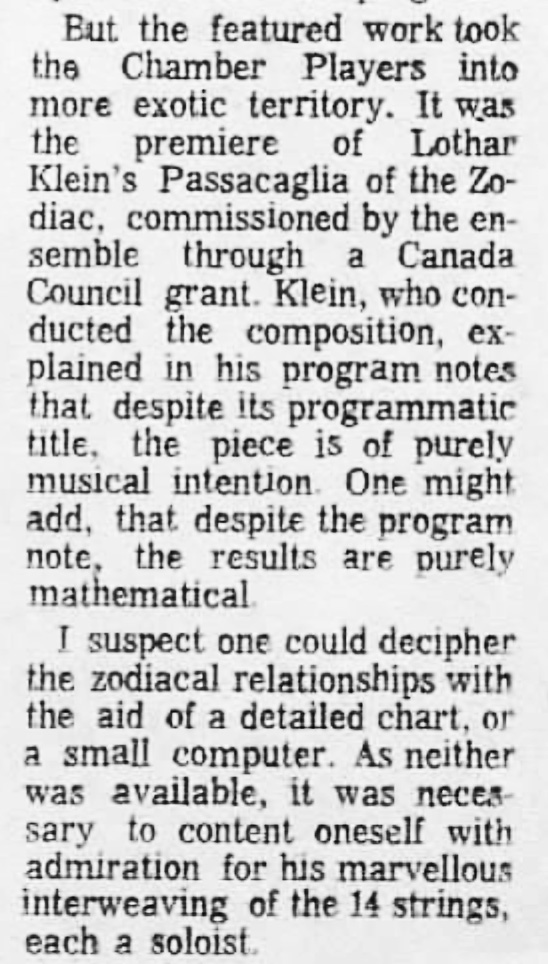
* Lothar Klein‘s “Passacaglia of the Zodiac”. Twelve variations for fourteen solo strings which, as the name might suggest, swirl and clash (not unattractively) on a cosmic stage. CPT commission through a grant from the Canada Council, performed in April 1972.
April 17, 1972
* Keith Bissell‘s “Variations on a Canadian Folk Song”. Educator, organist/choirmaster and composer, Bissell chose the French-Canadian folk song “Isabeau s’y Promène” as the inspiration for this piece. CPT commission through a grant from the Canada Council, performed in February 1973.
Listen to the original folk song 'Isabeau s'y Promène' sung by Alan Mills* Srul Irving Glick‘s “Symphonic Elegy”. “… with line drawing and funeral march …” a work dedicated to the memory of Glick’s father-in-law. CPT commission through a grant from the Canada Council, performed in April 1974.
* Godfrey Ridout‘s “Concerto Grosso”. CPT commission through a grant from the Canada Council, performed first in January 1975, again in May 1975 and February 1981. Recorded in March 1975. Listen on YouTube:
1st movement 2nd movement 3rd movementA Centrediscs recording: “Godfrey Ridout – The Concert Recordings” is available from the Canadian Music Centre, featuring four of Ridout’s works including this one.
“Chamber Players Series A concert II – included Godfrey Ridout’s Concerto Grosso for piano & strings (world premiere).” {January 18 1975}
“CBC Toronto Chamber Players recording for commercial record – 1st side – Godfrey Ridout’s Concerto Grosso (with piano).” {March 2 1975}
“Chamber Players CBC concert at Eaton Auditorium. I play the Ridout Concerto Grosso.” {May 29 1975}
“Chamber Players 2nd non-baroque concert. I play the Concerto Grosso by Ridout.” {February 21 1981}
* Murray Adaskin‘s “In Praise of ‘Canadian Painting in the Thirties'”. Adaskin’s tribute to three admired artists seen in that exhibition: Paraskeva Clark, Louis Muhlstock and Charles Comfort. CPT commission through a grant from the Canada Council, performed twice in January 1976.
Listen to Adaskin's 'In Praise of 'Canadian Painting in the Thirties'“Chamber Players plays at Arts & Letters Club – I play in the Murray Adaskin commissioned work.” {January 14 1976}
“Chamber Players 2nd non-baroque concert. I play only in the Adaskin commissioned work. Party at the Martins.” {January 24 1976}
* Harry Freedman‘s “Chalumeau”. A work for clarinet and string quartet. Commissioned with the CBC, performed in February 1982.
* Harry Somers‘ “Concertante”. Lorand Fenyves was the violin soloist; Robert Becker and Russell Hartenberger were the percussionists. Commissioned with the assistance of the Canada Council for violinist Lorand Fenyves. Performed in February 1983.
Listen to Somers' Concertante(begins with an informative introduction by Harry Somers)
* Gary Kulesha‘s “Lifesongs”. Set to four poems written by Kulesha, this work deals with some of humanity’s fundamental preoccupations. Commissioned through a grant from the Ontario Arts Council for soloist Maureen Forrester. Performed November 1985 in Markham and November 1986 in Toronto.
Listen to Gary Kulesha's 'Lifesongs'(live recording from 1985 performance)
* Harry Freedman’s “Contrasts: The Web and the Wind”. A mood: “very soft, atmospheric and lyrical” gives way to another: “dynamic and energetic”, these qualities suggested by a poem. Commissioned with the support of the Ontario Arts Council. Performed in November 1986.
* Jacques Hétu‘s “Poème”. Subtitled “A Celebration of Peace”, the work is based on the words, rhythms and emotions of Paul Éluard’s poem “Liberté”. Commissioned by CPT, performed in November 1989.
Two additional commissions were not music, but music-related:
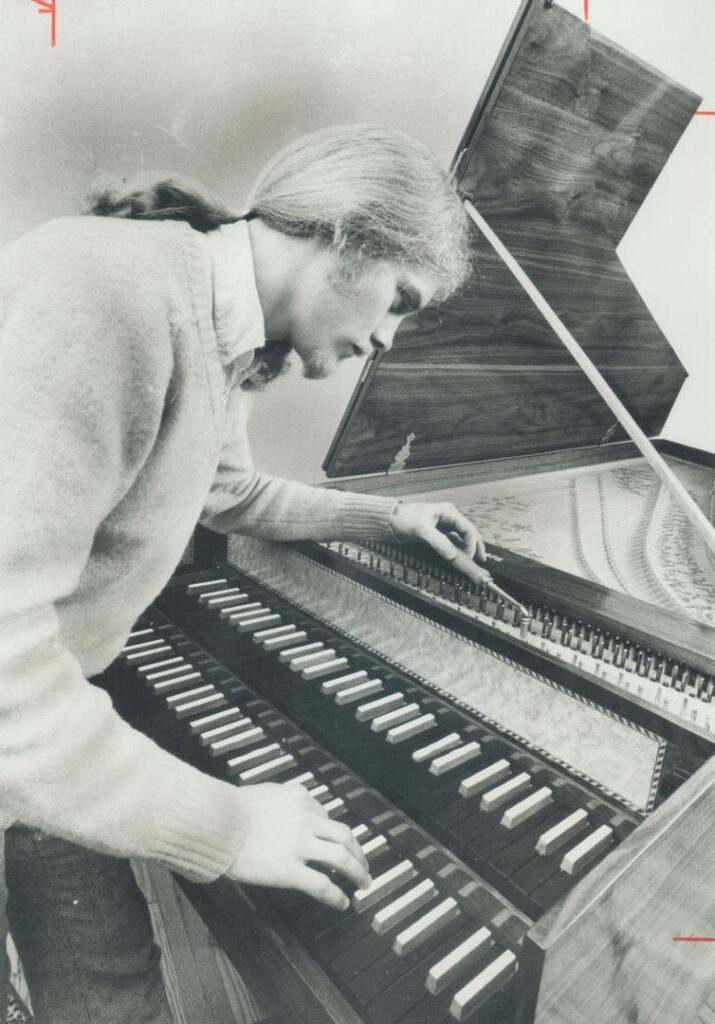
* A harpsichord, from maker Matthew James Redsell. Subsidized by a Wintario grant and an anonymous donor. Premiere performance December 1976.
“Chamber Players Series BI (Baroque). I play the Bach A major concerto on new harpsichord built by Matthew Redsell.” {December 3 1976}
* A poster, “Death and the Maiden”, designed by Canadian artist Tim Forbes and advertised in the April 29 1988 program. Limited edition prints were available for purchase; the original poster was offered as the prize in CPT’s Anniversary Draw.
It is to be hoped that, somewhere, the Matthew James Redsell harpsichord built in 1976 for The Chamber Players of Toronto still exists.
And somewhere, there must be a poster “Death and the Maiden” designed in 1988 by artist and graphic designer Tim Forbes.
I’ll leave it to any reader who knows about either of these to get in touch.
EPILOGUE : What does it mean to be part of a group for 23 years?
If you asked George this question, he might reply by showing you his 16 diary entries that specifically mention concerts given by The Chamber Players of Toronto in which he played solos (on either piano, organ or harpsichord):
“Chamber Players concert. I play harpsichord in 4, piano in Bloch Concerto Grosso.” {April 18 1971}
“To Waterloo with Chamber Players, for concert at University. I play the Bloch Concerto Grosso.” {November 11 1972}
“Chamber Players 1st concert of series at E.J.B., & extra one in afternoon. I play the Bloch Concerto Grosso.” {December 9 1972}
“Chamber Players concerts 2.30 & 8.30 in which I play Handel’s Bb Concerto no.2 & the Albinoni Adagio on the E.J.B. organ.” {December 8 1973}
“Chamber Players Bach concert, playing concerto for flute, violin & harpsichord, afternoon & evening.” {March 9 1974}
“Chamber Players Series A concert II – included Godfrey Ridout’s Concerto Grosso for piano & strings (world premiere).” {January 18 1975}
“Chamber Players concert – last of the non-baroque, & I play only in evening concert – the Bloch Concerto Grosso.” {March 15 1975}
“Final Chamber Players concert – all Bach, Brandenburg 4 & 5, three-violin concerto, & Cantata 51.” {April 19 1975}
“Chamber Players CBC concert at Eaton Auditorium. I play the Ridout Concerto Grosso.” {May 29 1975}
“Last concert of Chamber Players Baroque series programme I. I play Bach E major concerto.” {April 30, May 1 1976}
“Chamber Players Series BI (Baroque). I play the Bach A major concerto on new harpsichord built by Matthew Redsell.” {December 3 and 4 1976}
“Chamber Players Baroque concert(s). I play Bach harpsichord concerto in D minor.” {February 24 and 25 1978}
“Chamber Players 3rd concert in Hamilton.” {February 26 1978}
“Chamber Players Baroque II concert. Jane Coop plays 2 Bach Concertos on piano. I play Albinoni Adagio on organ, & two harpsichord numbers.” {January 10 1981}
“Chamber Players 2nd non-baroque concert. I play the Concerto Grosso by Ridout.” {February 21 1981}
“Chamber Players perform in Peterborough (I take a taxi at 6 p.m.). Programme included Bloch’s ‘Concerto Grosso’”. {November 5 1981}
But more than that, he played dozens and dozens of concerts seated at the harpsichord in his supportive role as continuo player.
The Chamber Players of Toronto was quite a different group at its end than it was at its beginning; comparing the players’ lists from 1969 and 1992, you’ll see no common names among the two, except for one: “George Brough harpsichord”.
This, with all the commitment it implies within a busy musical life, was what it meant for George to be part of the group for 23 years.
There’s something else too, of prime significance:
He thought to write it all down in diaries, and he found it important to save those many programs.
Had he not done this, I would not have a huge body of work to draw upon for my musical tales.
But he did, and so I do; and so the stories of The Chamber Players of Toronto may spin on for years to come.