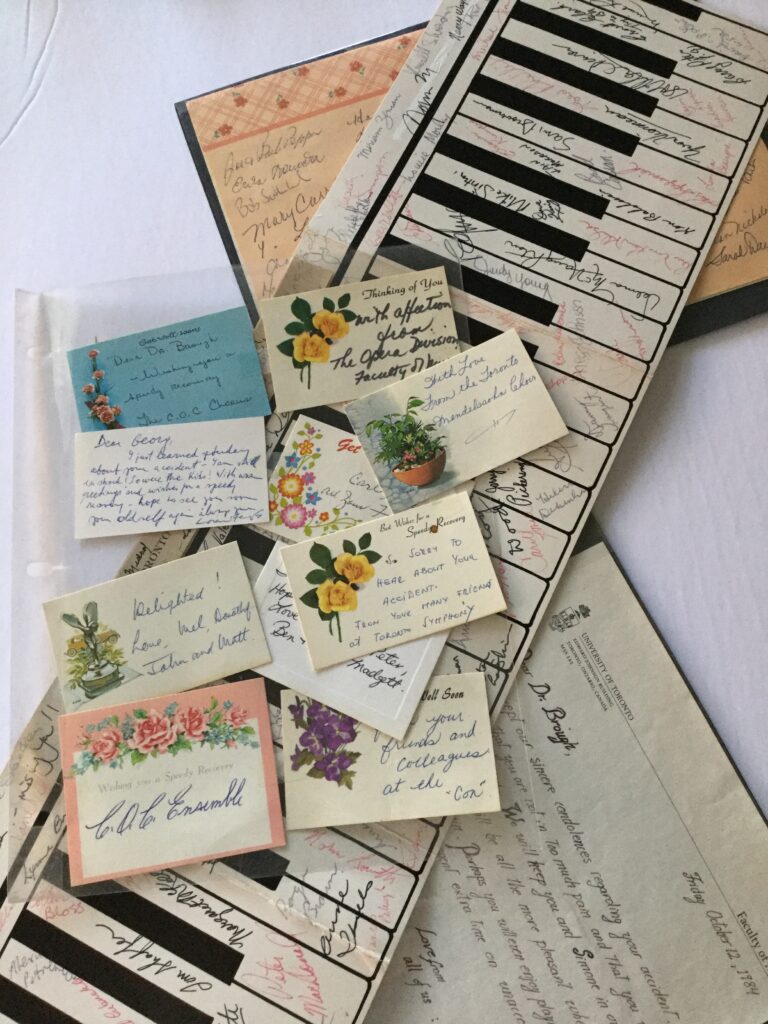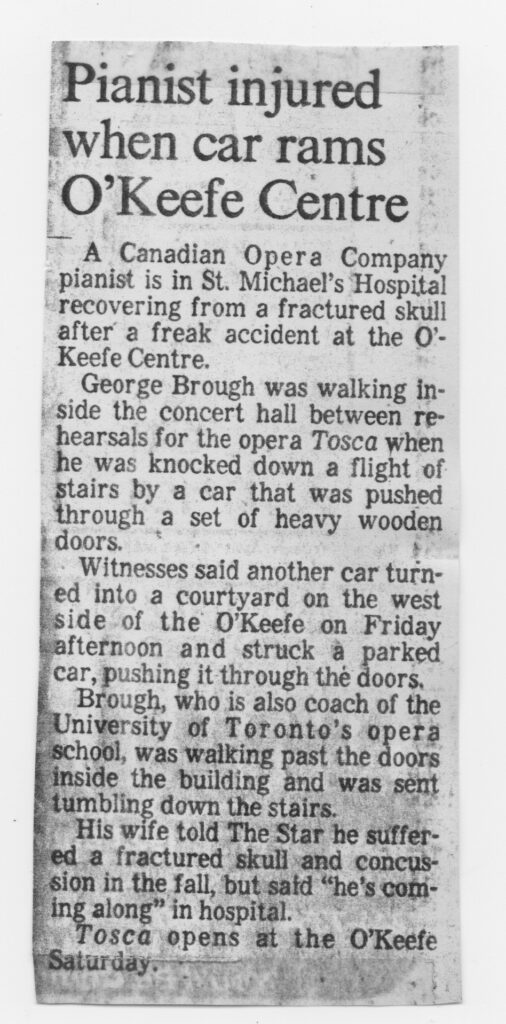
“Accident day – in O’Keefe Centre – to St. Michael’s Hospital for stitches in the head & a sojourn of 3 days … I receive immense number of flowers & cards from concerned friends.” {October 5 1984}
“I am allowed to come home. A nurse comes in for a few days from the V.O.N. to dress the head wound.” {October 8}
“I miss the rest of the Trovatore performances, all the Toscas, two weeks of Faculty Opera, one Mendelssohn Choir.” {October 9}
“Nothing much happens except the continued arrival of cards & flowers …” {October 10}
“Back to St. Michael’s to have stitches removed (not to stay in hospital).” {October 15}
“Work again! (Tosca III)”
“Playing for one audition to-day & one to-morrow for CBC Talent Festival – one bassoon & one viola.” {October 18}
Making music is a glorious thing, but it’s no secret that having to adapt the human body to an instrument in order to produce musical sounds can result in injuries ranging from mild to serious. With a judicious approach to practice and a bit of luck, a musician may avoid many potential hazards. But what if the injury is caused by something entirely out of that musician’s control?
Consider for example our indomitable collaborative pianist George Brough, known for his stamina, for his willingness to jump in and embrace the opportunity to play anything playable (and sometimes things not playable) on the keyboard, as long as he could possibly fit the rehearsals and performances into his schedule. George was often plagued with aching neck and shoulder muscles; he frequently sought the salve of a massage therapist to help him get through long days packed with rehearsals and concerts.
But nothing in all his experience could have prepared him for that day in October 1984 when, taking a lunch break during rehearsals for the Canadian Opera Company’s production of Tosca at the (then) O’Keefe Centre, he was sent flying down a staircase, knocked out cold by a domino effect caused by a car hitting a van hitting a door which then hit him.
How could the designers of that famous concert hall (which opened in 1960) ever dream of the plausibility of an indoor car accident? To understand how it happened one must know a bit about the former layout of the building and grounds at the south-east corner of Toronto’s Yonge and Front Streets: Outdoors along the west side, a parking lot where a large door to the building loomed, used (no doubt) to receive large objects such as stage sets. Indoors along the west side, a passage extending from back to front of the building, with stairs partway along leading down to a lower floor.
Thus sets the scene for an occurrence that could hardly be staged deliberately:
A van parks in the parking lot, facing the large door. Inside, George (who rarely walked slowly) makes his way along the passage from a rehearsal room at the back of the building to the front lobby, intending to eat there the lunch he had brought. A car pulls into the parking lot and does not stop, slamming into the van which crashes through the door at just the instant moment George is beside it. He is found unconscious at the bottom of the stairs – concussion, broken teeth, whiplash, fractured skull – and rushed to hospital.
In the days to follow they watch him very closely. His initial confusion clears and cognition is regained relatively quickly; he is allowed home within three days, with a nurse regularly scheduled to come in and change the dressing on his wound.
He is not supposed to work at all. He must rest and heal.
Within two weeks he’s climbing the walls at home and can’t wait to get back to rehearsals and activities with the COC, the Mendelssohn Choir, the UofT Faculty of Music. In a short time he is back to normal, with the exception that his chronically sore neck (probably caused by so much leaning over a keyboard) is much less sore than it has been in years.
Everybody is very happy and the world turns as it should . . .